Lateral movement
Side-to-side coverage on a 20-foot-wide court, repeated for the length of a session. Hips, ankles, and a stable trunk share this work.
Sports Movement Lab · Pickleball
Pickleball asks for short, sharp changes of direction, a stable base at the kitchen line, and the ability to reset between points — often for two hours at a time. These are the movement qualities behind that.
Movement demands
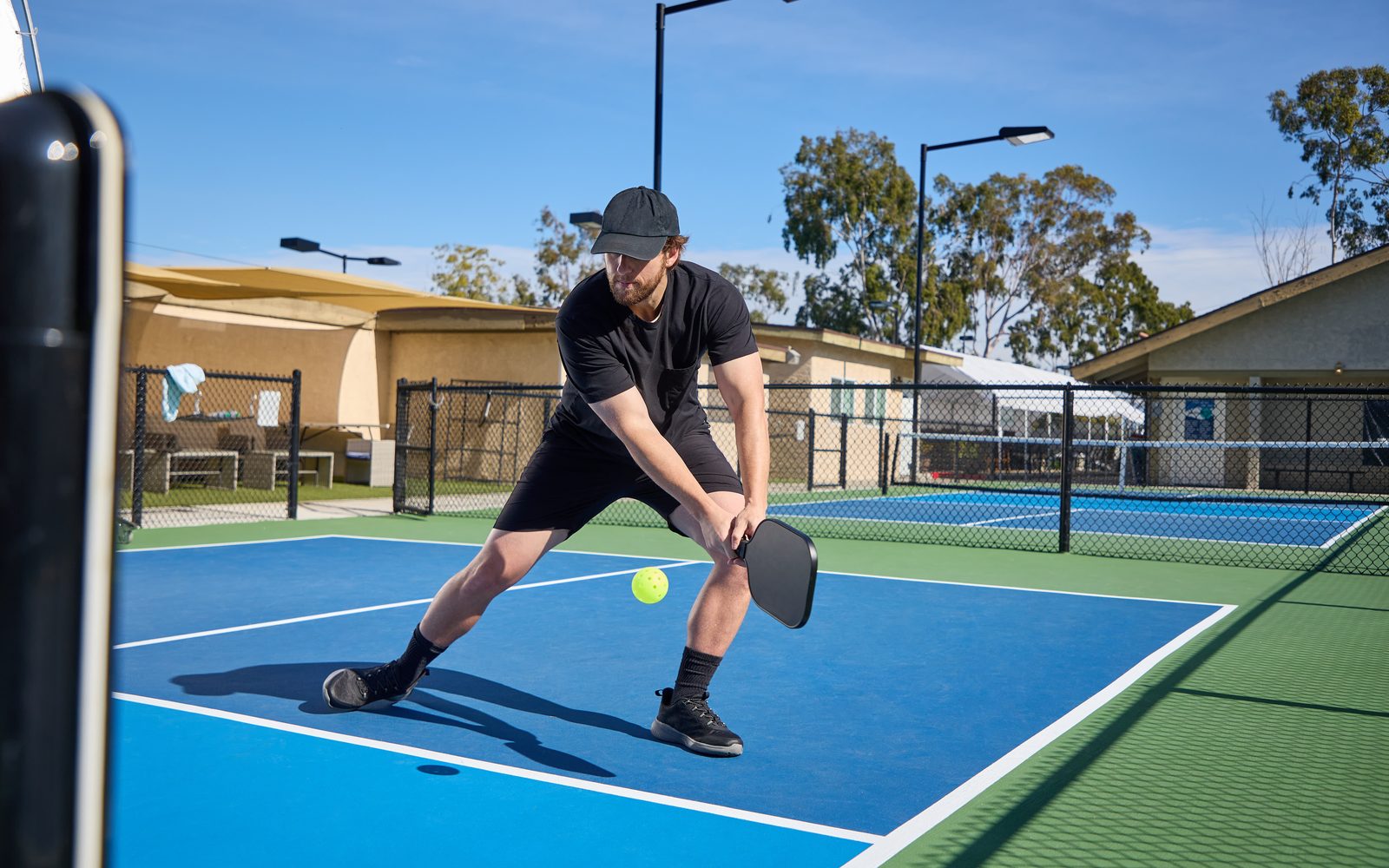
Pickleball rewards players who can start, stop, and change direction without losing their base. Most of that happens below the waist and behind the shoulder: hips and ankles that move freely, a first step that fires without hesitation, and enough upper-back rotation to reach a ball that is already past you.
Side-to-side coverage on a 20-foot-wide court, repeated for the length of a session. Hips, ankles, and a stable trunk share this work.
The split step and the move that follows it. This is about being able to load and unload quickly, not about raw speed.
Staying upright and ready while reaching, especially at the kitchen line and on a stretched-out dink.
Ankles that dorsiflex and hips that rotate give you a low, stable base. When either is stiff, the knees and low back tend to take up the difference.
Overheads, resets, and serves ask the shoulder blade and thoracic spine to move together rather than the arm working alone.
Rec play often runs two or three hours. Moving between games — rather than standing still — is part of the sport, not an extra.
Interactive 3D Tool
Rotate a 3D model through key pickleball movement phases, see what each position asks of your body, and reflect on where your own motion feels restricted.
Self-check
Tick anything you notice. This is an observation exercise, not a test, and there is no score.
Nothing here is stored or sent anywhere. Ticking boxes changes nothing but the note above.
Preparation
General preparation ideas, not a prescribed programme. Move within a comfortable range, and stop if anything is painful.
Local courts
Three public options, taken from the cities' own pages. Call ahead — open-play times and fees change with the season.
Deerfield Beach
217 NE 5th Ave, Deerfield Beach, FL 33441
Deerfield Beach
445 SW 2nd Street, Deerfield Beach, FL 33441
Boca Raton
2000 NW 51st Street, Boca Raton, FL 33431
Checked against official city pages on August 23, 2026. Aligned In Motion is not affiliated with these facilities and does not manage their programmes. Hours, fees, and court availability change — confirm with the facility before you go.
Questions people ask
No, and nobody honestly can promise that. Skill comes from playing and from coaching. What a movement evaluation can tell you is where your range of motion is limited and whether that limitation is something chiropractic care is appropriate for. Whether better movement shows up in your results is up to you and your coach.
Often more so. New players tend to arrive with a movement history — desk work, an old ankle sprain, years away from side-to-side sport — and pickleball asks for all of it at once. Knowing where your movement is limited before you build a habit around it is useful.
Plenty of people come in to understand how they move rather than because something hurts. A movement evaluation is an assessment of range and quality, and the absence of pain is a good time to have it done rather than a reason to skip it.
Have it looked at properly rather than working around it. Call the office at 561-831-5222 and describe it. Pain that is sharp, worsening, or that follows a specific injury deserves an appropriate evaluation, and that may or may not be chiropractic.
Dr. Bob's background
Dr. Bob is a Florida-licensed chiropractic physician. A sports movement evaluation assesses range of motion and movement quality. It is not coaching, it does not include a training plan, and it does not promise improvements in score, speed, distance, or athletic performance.
Also in the lab
Pickleball movement evaluation
An individual appointment with Dr. Bob to assess range of motion and movement quality. Educational and evaluative — not coaching, and not a promise of athletic improvement.
Prefer to talk? 561-831-5222